Maltas Lab logo
Overview

The primary goal of our research is to understand, predict, and ultimately control evolution.

Work from multiple disciplines – including ecology, statistical physics, and economics – reveals that complex systems are often dominated by emergent behavior not easily recognizable from the behavior of the constituent parts. In a similar spirit, using tools from population genetics, game theory, and statistical physics, we aim to understand how evolution at the population-level emerges from its constituent parts: competition/cooperation between lineages, population density, spatial heterogeneity, and fluctuating environments.

To do so, we combine wet lab experiments (e.g. DNA barcoding, continuous culture devices) with theoretical tools from population genetics, statistical physics, and evolutionary game theory to understand how large asexual populations like bacteria and cancer evolve, particularly in response to treatment.

Critically, many of the most challenging public health concerns worldwide are the result of evolving diseases such as cancer, COVID-19, and antibiotic resistance. As such it is imperative to translate our understanding of these fundamental processes into a testable theoretical framework to help us better forecast, and ultimately control, the evolution of these systems.
  • 1

    Intersection of ecological and evolutionary timescales and the effect on adaptation

    Traditionally, ecological processes that define a population are assumed to be fast, while evolutionary processes are comparatively slow. However, in large asexual populations such as bacteria, viruses, cancer, and fungi, this separation is not often accurate. In the large asexual populations, beneficial mutations don't just change the average fitness; they can rapidly alter the populations size. Further, mutations often exhibit frequency-dependent (or density-dependent) phenotypes that continue to complicate a traditional separation of timescales.

    Instead, we seek to understand the evolution of large asexual populations at the intersection of these processes. This involves experiments where we work to understand under which conditions is the traditional assumption violated, co-competition assays where we identify frequency-dependent phenotypes, and theory work where we seek to integrate these observations into traditional population genetics frameworks.

    Representative Publications:
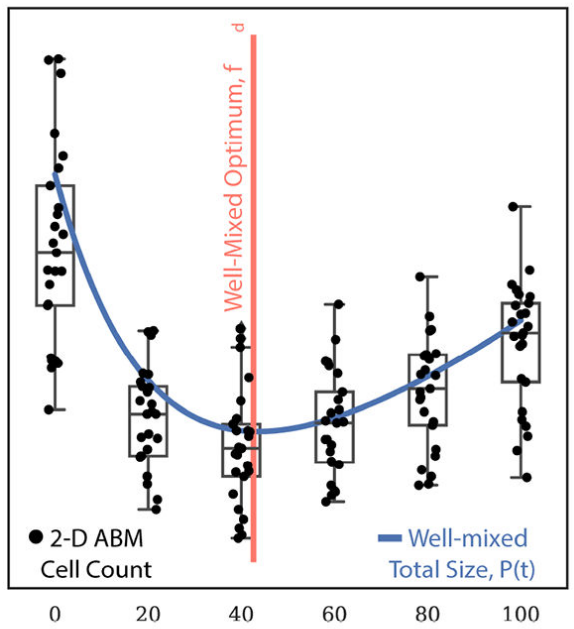
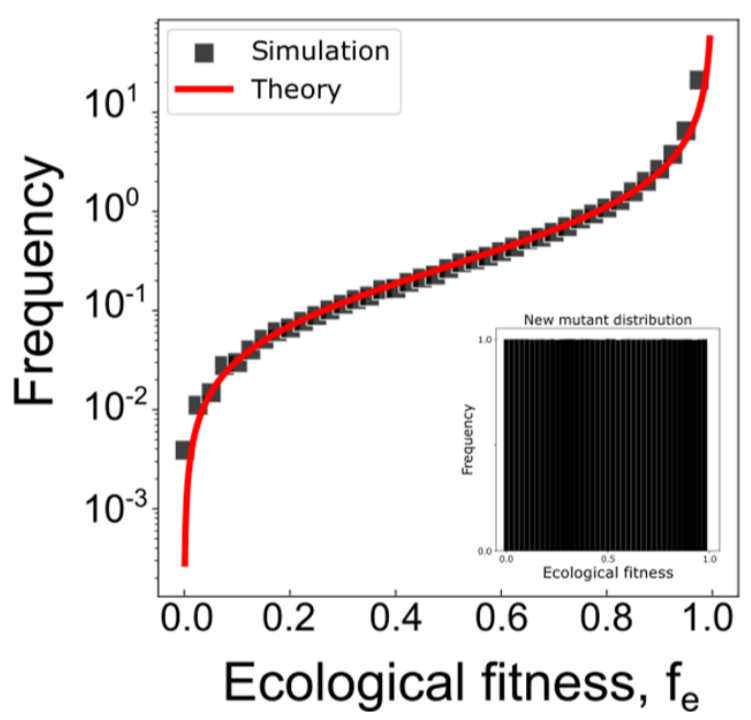
    Figure from 2024 PRX Life publication
    Frequency-dependent ecological interactions increase the prevalence and shape the distribution, of preexisting drug resistance.
    Jeff Maltas, Dagim Shiferaw Tadele, Arda Durmaz, Christopher D. McFarland, Michael Hinczewski, and Jacob G. Scott.
    PRX Life, 2024
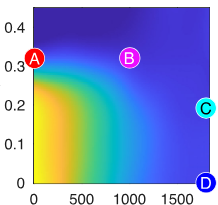
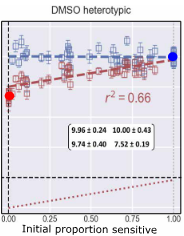
    Figure from 2022 Science Advances publication
    Measuring competitive exclusion in non–small cell lung cancer
    Nathan Farrokhian*, Jeff Maltas*, Mina Dinh, Arda Durmaz, Patrick Ellsworth, Masahiro Hitomi, Erin Mcclure, Andriy Marusyk, Artem Kaznatcheev, and Jacob G. Scott
  • 2

    Predictability and controllability of eco-evolutionary systems

    Whether it is an invasive or endangered species within an ecosystem, or a resistant tumor or bacterial infection within a patient, there is an enormous desire to predict, and ultimately control, eco-evolutionary processes. Yet the same forces that make these populations so difficult to manage, rapid adaptation and tightly coupled ecological and evolutionary dynamics, also create opportunities. If we can anticipate how a population will respond to a perturbation, we can begin to steer it toward outcomes we desire.

    The goal of this work is to leverage eco-evolutionary forces to control eco-evolutionary processes. For example, we study how collateral sensitivity and resistance in bacteria can be exploited to design antibiotic therapies that constrain the evolution of resistance, and how adaptive therapy in cancer can be used to manage drug-dependent populations rather than maximally suppress them. In each case, we combine experiments and theory to identify when these strategies succeed, when they fail, and how robust they are to the inherent unpredictability of evolution.

    Representative Publications:
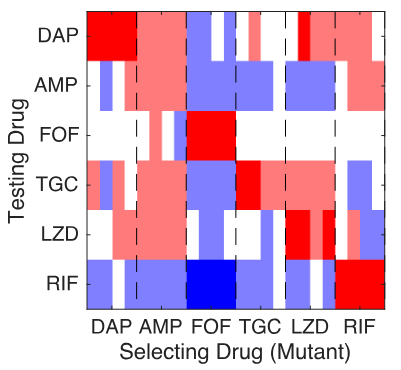
    Figure from 2023 NEE publication
    Drug dependence in cancer is exploitable by optimally constructed treatment holidays
    Jeff Maltas*, Shane T. Killarney*, Katherine R. Singleton, Maximilian A. R. Strobl, Rachel Washart, Kris C. Wood, and Kevin B. Wood
  • 3

    Understanding evolution in multiple environments

    Living organisms are consistently challenged with dynamic environments. These environments are often the combination of many potential distinct environments (e.g. multiple carbon sources, multiple toxins or stressors). Multi-drug combinations such as those used to treat cancer, HIV, or bacterial infections make for a excellent model system to understand this phenomenon with clear translational benefit.

    Some pairs of drugs exhibit particularly strong inhibitory effects when used simultaneously, as each drug magnifies the other, a phenomenon known as synergy. Other drug combinations may dampen on another, a phenomenon known as antagonism. Recent work as highlighted how these interactions also impact the speed at which populations evolve, and what types of phenotypes emerge. We seek to understand how combinations of environments (typically drugs) direct and speed evolution, and how we might leverage to control a population.

    Representative Publications:
External Collaborators
Duke University
Case Western Reserve University
Michigan State University
Baylor College of Medicine